
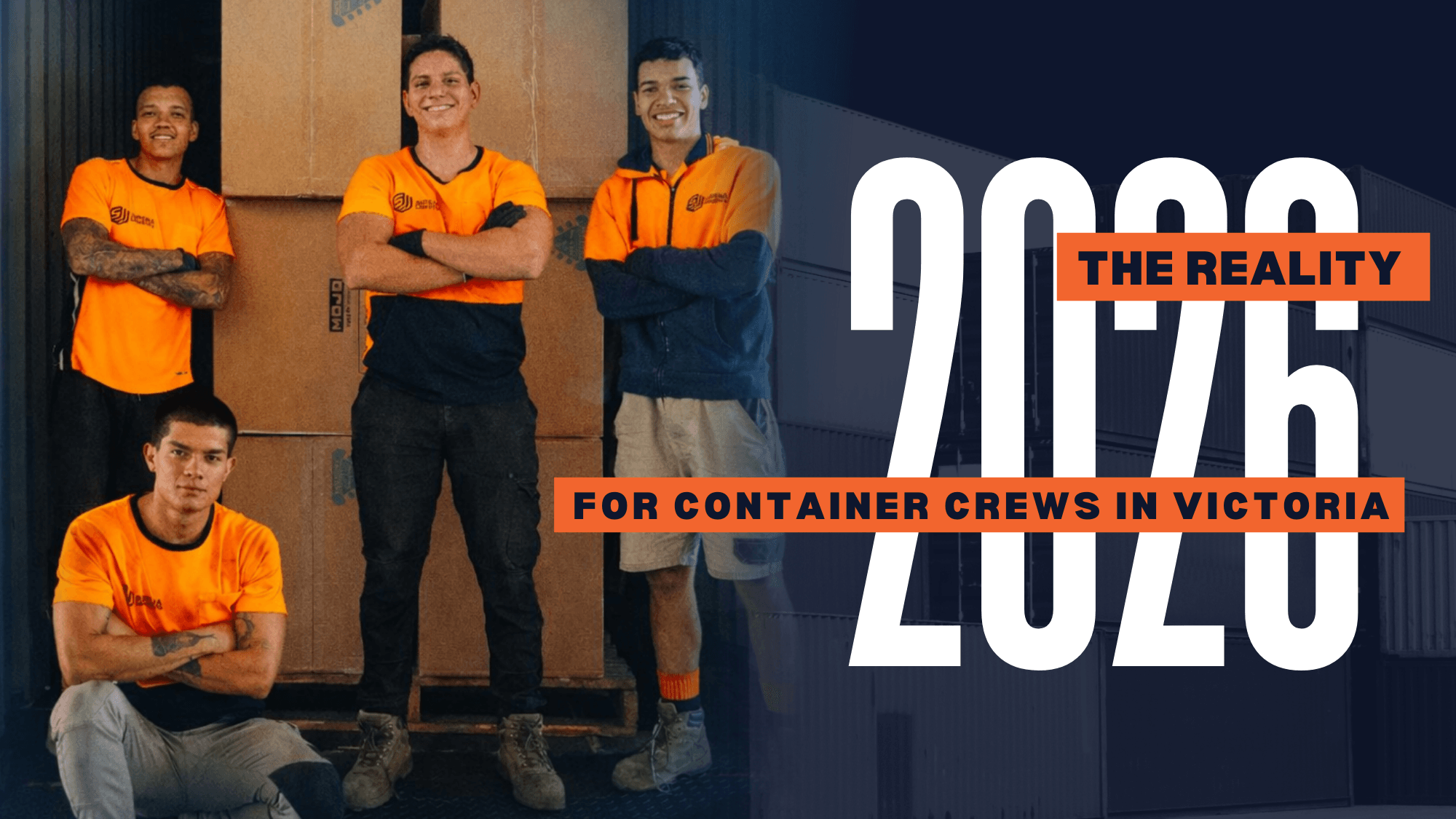
Peak seasons are arriving earlier. WHS inspectors are showing up unannounced. Customers now expect real-time proof of performance.
In 2026, container crews across Victoria are operating in a new environment, one that rewards teams who are fast, compliant, and data-driven.
The question is no longer “Can you unload the container?”
It’s “Can you unload it fast, safely, and prove it?”
Here’s what’s shifting in the industry, and how top-performing operators are adapting.
Peak Season Is No Longer Just November
For years, logistics teams built toward a predictable December surge. However, that rhythm has changed.
Import spikes now land in March, June, or October. Retailers are pulling stock earlier to outrun global supply chain disruptions. As a result, container volumes are spreading across the year instead of concentrating in one holiday rush.
What’s happening
Port of Melbourne processed record TEU volumes through FY25.
Retailers are front-loading inventory months ahead of traditional peak periods.
Devanning requests are running 24/7 for extended stretches.
Labour availability, however, hasn’t increased at the same pace.
In other words, the pressure isn’t seasonal anymore, it’s structural.
What smart operators are doing
Instead of waiting for December, high-performing operators are:
Maintaining a “warm bench” of pre-inducted crews who can activate within four hours across metro Melbourne.
Building flexible rosters that absorb multiple micro-peaks.
Cross-training workers to shift between sites without compliance delays.
Consequently, they stay responsive, even when import volumes spike unexpectedly.
WHS Compliance Is Now a Board-Level Issue
At the same time, compliance expectations have intensified. The Labour Hire Authority has increased surprise audits, and container handling remains on the regulator’s high-risk watchlist.
Previously, paper logbooks and verbal inductions might have passed. Today, they expose businesses to serious penalties.
Why it matters
Penalties escalate quickly when licences or SWMS records aren’t current.
Audit failures can disrupt operations and damage reputation.
Clients expect labour partners to reduce inspection risk, not add to it.
Therefore, compliance is no longer administrative, it’s strategic.
What “inspection-ready” looks like in 2026
Top operators have moved beyond paperwork. They now rely on:
Digital inductions, toolbox talks, and SWMS captured per shift
Real-time licence and ticket tracking across every crew member
Transparent reporting backed by Zero Lost Time Injury statistics
Because of this shift, audits become smoother, and client confidence increases.
Customers Want Data, Not Anecdotes
How Sipena Logistics Responds
Meanwhile, expectations from 3PLs, national retailers, and e-commerce DC managers have evolved. They benchmark suppliers on hard KPIs: containers per hour, first-time quality, absenteeism, and turnaround time.
In fact, labour partners are now measured the same way as warehouse management systems.
The new standard
Real-time timestamps for container start and finish
Exception logs with photographic proof
Weekly dashboards summarising productivity by site and shift
As a result, performance conversations are based on evidence, not opinion.
The payoff
When data is clear and accessible:
Procurement approvals happen faster
Finance sign-offs face fewer delays
Contract renewals become performance-driven instead of price-driven
Ultimately, documented performance protects margin.
At Sipena Logistics, we’ve built our container crew model around these new realities.
Activation Speed
Four-hour metro deployment windows and ready-to-go crews for regional clients. Because in 2026, waiting days isn’t an option.
Compliance Proof
All inductions, SWMS, and licences logged digitally, so you’re audit-ready at any moment.
Operational Data
Every shift feeds our reporting dashboards. Consequently, clients know exactly what was delivered, when it was delivered, and how it performed.
The Bottom Line for 2026
Victoria’s container crews are no longer operating in a predictable cycle. Instead, they’re navigating early peaks, tighter WHS scrutiny, and rising data expectations.
The teams that win in this environment share three traits:
Speed – Rapid deployment and flexible rostering
Compliance – Inspection-ready systems at all times
Visibility – Real-time operational data
If your network is feeling pressure from unpredictable import spikes, stricter compliance audits, or increasing KPI demands, now is the time to prepare.
Book a container-crew readiness consultation with Sipena Logistics and make sure your operation stays ahead of the 2026 reality
Contact us at info@sipenalogistics.com.au.
We’re ready at Sipena Logistics.